As an Amazon Associate I earn from qualifying purchases. Picks are based on manufacturer specs, independent reviews and owner reports.
Our top picks
Short on time? Our top recommendation is the Excalibur D900CDSHD 9-Tray Food Dehydrator.
Compare
At a glance
The traits that separate these picks, side by side.
| # | Product | Best for | Key feature | |
|---|
| 1 | | — | 9 stainless steel trays, 15 square feet of drying space | Check ↗ |
| 2 | | — | 5 trays included, expandable up to 12 | Check ↗ |
| 3 | | — | 10 stainless steel trays, 16.2 square feet of drying space | Check ↗ |
| 4 | | — | 6 trays included, expandable to 12 | Check ↗ |
In depth
The 4 best, explained
Why each made the cut, where it falls short, and who should buy it.
Top pickExcalibur
Horizontal airflow dries every tray at nearly the same rate, meaningful for large jerky batches
- 9 stainless steel trays, 15 square feet of drying space
- Parallex horizontal airflow, no tray rotation needed
- 26-hour digital timer with auto shut-off
- Adjustable thermostat, 105°F to 165°F
- Clear door for monitoring progress
✓ Pros
- Horizontal airflow dries every tray at nearly the same rate, meaningful for large jerky batches
- 9-tray capacity handles several pounds of meat in a single run
- Stainless steel trays hold up better under repeated meat use than plastic
- Temperature range reaches the 160°F needed for the USDA-recommended safe start
✕ Cons
- Large footprint takes up significant counter or pantry space
- Louder fan than compact vertical dehydrators
NESCO
Keep in mind that top-mounted single fan means the tray closest to the fan dries faster, so rotation helps.
- 5 trays included, expandable up to 12
- 600W top-mounted fan with Converga-Flow drying
- Adjustable thermostat, 95°F to 160°F
- Jumbo Works beef jerky kit included with some bundles
- Compact stackable design
✓ Pros
- Included jerky kit (gun, seasoning, cure) gets first-timers started without extra purchases
- 160°F ceiling covers the USDA-recommended safe starting temperature for meat
- Expandable tray system lets you scale up gradually instead of buying a large unit upfront
- Among the highest rating counts in the category, a sign of a long, proven track record
✕ Cons
- Top-mounted single fan means the tray closest to the fan dries faster, so rotation helps
- 5 trays out of the box is modest for large jerky batches without buying add-on trays
- Round tray shape wastes some space compared to square trays for laying out strips
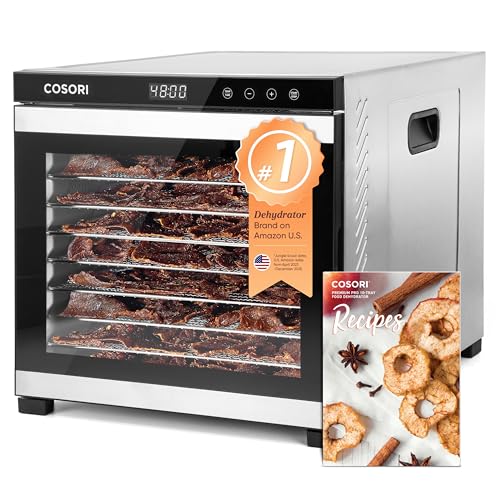
COSORI
2 square feet of drying space and 1000W element with rear-mounted horizontal airflow. Keep in mind that newer to the category than Excalibur or NESCO, with fewer years of long-term owner data.
- 10 stainless steel trays, 16.2 square feet of drying space
- 1000W element with rear-mounted horizontal airflow
- 95°F to 165°F in 1°F increments
- 48-hour digital timer
- Jerky, fruit, vegetable, and yogurt presets
✓ Pros
- 1°F increment control makes it easy to hold a precise 160°F for the safe-start step
- 10-tray capacity rivals the Excalibur at a lower typical price
- Rear-mounted fan with horizontal airflow reduces the need for tray rotation
- Dedicated jerky preset removes the guesswork for a first attempt
✕ Cons
- Newer to the category than Excalibur or NESCO, with fewer years of long-term owner data
- Trays are a slightly tighter fit than the Excalibur's for thick-cut strips
- Digital touch panel has more to go wrong long-term than a simple analog dial
Presto
And nesting trays make this the easiest of the four to store between uses. Keep in mind that bottom fan means trays closer to the base dry faster, so rotation is recommended for even jerky.
- 6 trays included, expandable to 12
- Digital thermostat and timer, 90°F to 165°F
- Bottom-mounted fan and heating element
- Trays nest for storage, over 40% smaller footprint stored
- Includes fruit roll sheets and mesh screens
✓ Pros
- 165°F ceiling covers the full jerky safe-start range with room to spare
- Nesting trays make this the easiest of the four to store between uses
- Digital timer and thermostat give more precise control than older dial-based Presto models
- Lower price point than Excalibur or COSORI for buyers testing out jerky-making
✕ Cons
- Bottom fan means trays closer to the base dry faster, so rotation is recommended for even jerky
- 6-tray starting capacity is modest for anyone planning large batches immediately
- Round trays waste some corner space compared to the square Excalibur and COSORI trays
How we chose these picks
This shortlist is the product of research, not advertising. We cross-checked manufacturer specs against independent reviews and long-term owner feedback, then ranked by value for real use cases.
Mistakes buyers often make
- Choosing the cheapest option without checking warranty and support quality.
- Assuming all models work with your existing setup, verify compatibility first.
- Skipping the measurements: returns most often come from fit surprises.
- Chasing the newest release when last year's model does the same job for less.
How to choose: the factors that matter
- Capacity and sizing — Measure your space and your actual use before falling for bigger-is-better. The right size is the one that fits your routine, not the spec sheet's maximum.
- Build quality and materials — Heavier-gauge materials, tight tolerances, and solid joints outlast thin, rattly construction. In reviews, look for longevity comments over first-impression praise.
- Ease of use and setup — Clear instructions, intuitive controls, and minimal assembly separate daily drivers from garage ornaments.
- Maintenance and cleaning — Whatever you buy will need cleaning. Removable, dishwasher-safe, or wipe-clean parts get maintained; fiddly ones get neglected.
- Warranty and support — A multi-year warranty signals the manufacturer expects it to last. Check what's actually covered, motors and frames matter more than accessories.
The bottom line
There's no single 'best' here, only the best match for your situation. Start from your must-have features, then choose the least expensive pick that covers them.
FAQ
Common questions
What are the best food dehydrators for jerky right now?
Our top pick is the Excalibur D900CDSHD 9-Tray Food Dehydrator (top pick), because horizontal airflow dries every tray at nearly the same rate, meaningful for large jerky batches. The runner-up is the NESCO FD-75A Snackmaster Pro Food Dehydrator, followed by the COSORI Premium 10-Tray Stainless Steel Food Dehydrator.
Is the Excalibur D900CDSHD 9-Tray Food Dehydrator worth it?
For most buyers, yes. It ranks #1 in our food dehydrators for jerky research, though large footprint takes up significant counter or pantry space.
What temperature should I dehydrate jerky at?
The USDA recommends drying meat at 160°F to kill bacteria before the dehydrating process, then maintaining 130°F to 140°F for the remaining drying time. Many dehydrator recipes skip the initial high-heat step and instead recommend pre-cooking marinated strips in an oven to 160°F before transferring them to the dehydrator to finish drying. Check your specific dehydrator's manual and a current USDA meat processing guide before your first batch, since food safety margins matter more with meat than with fruit or vegetables.
Do I need a dehydrator with a fan, or does a low oven work for jerky?
A dedicated dehydrator with a fan produces more consistent results than an oven. Ovens rarely hold a stable temperature below 170°F to 200°F, which is too hot and dries the outside of jerky strips before the inside finishes, and most ovens lack the airflow needed to move moisture away from the meat surface evenly. A dehydrator with a rear or bottom-mounted fan and a true 130°F to 160°F range is built specifically for this job and produces more even texture edge to edge.
How long does beef jerky take to dehydrate?
Most 1/4-inch strips take 4 to 8 hours at 130°F to 160°F, depending on the dehydrator's airflow design and how much moisture was in the meat before drying. Horizontal airflow dehydrators like the Excalibur tend to dry more evenly across every tray without rotation, while vertical stack models with a single bottom or top fan often need trays rotated partway through to avoid the classic problem of the top or bottom tray finishing first.
Do I need to rotate trays for even jerky drying?
It depends on the airflow design. Horizontal (side-mounted) airflow dehydrators, like the Excalibur, push air evenly across every tray at once, so rotation generally is not needed. Vertical stack dehydrators with a single fan at the top or bottom, like many NESCO and Presto models, dry the tray nearest the fan faster than trays farther away, so rotating trays halfway through the cycle produces more even results.
Keep researching
Related guides & comparisons