As an Amazon Associate I earn from qualifying purchases. Picks are based on manufacturer specs, independent reviews and owner reports.
Our top picks
Short on time? Our top recommendation is the COSORI Premium 10-Tray Stainless Steel Food Dehydrator.
Compare
At a glance
The traits that separate these picks, side by side.
| # | Product | Best for | Key feature | |
|---|
| 1 | | — | 10 stainless steel trays, 16.2 square feet of drying space | Check ↗ |
| 2 | | — | Includes 2 fruit roll sheets in the box | Check ↗ |
| 3 | | — | 5 trays included, expandable to 12 | Check ↗ |
| 4 | | — | 9 stainless steel trays, 15 square feet of drying space | Check ↗ |
In depth
The 4 best, explained
Why each made the cut, where it falls short, and who should buy it.
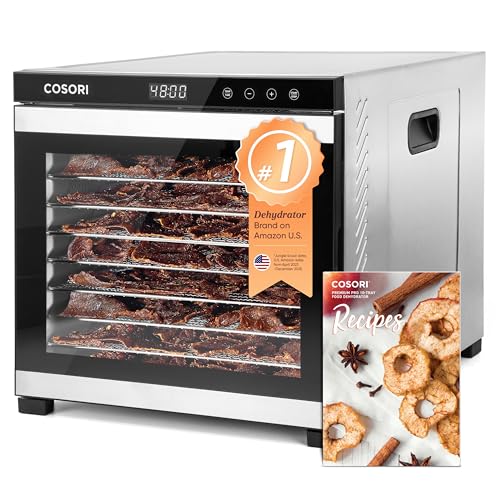
Top pickCOSORI
2 square feet of drying space and Fruit preset dials in the right temperature automatically. One caveat, fruit roll sheets sold separately from the base unit in some bundles.
- 10 stainless steel trays, 16.2 square feet of drying space
- Fruit preset dials in the right temperature automatically
- 95°F to 165°F in 1°F increments
- Rear-mounted horizontal airflow
- 48-hour digital timer
✓ Pros
- Fruit preset removes the guesswork on temperature for first-time leather makers
- 10-tray capacity means a full day's fruit haul can go in as leather in one batch
- Horizontal airflow dries sheets evenly without needing to rotate trays
- 1°F precision keeps leather from overshooting into a brittle, crackly texture
✕ Cons
- Fruit roll sheets sold separately from the base unit in some bundles
- Large 10-tray footprint takes real counter space during a long dry
- Higher price than the NESCO for buyers who only want to make leather occasionally
Presto
Fruit roll sheets included out of the box, no separate purchase needed to start
- Includes 2 fruit roll sheets in the box
- Digital thermostat and timer, 90°F to 165°F
- 6 trays included, expandable to 12
- Bottom-mounted fan
- Nesting trays for compact storage
✓ Pros
- Fruit roll sheets included out of the box, no separate purchase needed to start
- Digital thermostat holds the 135°F to 140°F leather range accurately
- Lower price than COSORI or Excalibur for occasional leather makers
- Nesting trays make this easy to store when not drying a batch
✕ Cons
- Bottom fan dries the lowest tray faster, so rotating trays partway through helps
- 6-tray starting capacity limits how much leather you can dry in one run
- Round trays mean cutting rectangular fruit roll sheets to fit isn't always exact
NESCO
One caveat, fruit roll sheets are an added purchase, not included with the base unit.
- 5 trays included, expandable to 12
- 600W top-mounted fan
- Adjustable thermostat, 95°F to 160°F
- Compact stackable design
- Fruit roll sheets available as an accessory
✓ Pros
- Lowest typical price of the four, a low-commitment way to try making leather
- 160°F ceiling comfortably covers the 135°F to 140°F leather range
- Compact stackable footprint fits in smaller kitchens between uses
- Large, proven track record with tens of thousands of ratings
✕ Cons
- Fruit roll sheets are an added purchase, not included with the base unit
- Top-mounted single fan means top trays dry faster than bottom ones
- 5-tray starting capacity is limiting for anyone processing a large fruit haul at once
Excalibur
Horizontal airflow dries every sheet at nearly the same rate across all nine trays
- 9 stainless steel trays, 15 square feet of drying space
- Parallex horizontal airflow, no rotation needed
- Adjustable thermostat, 105°F to 165°F
- 26-hour digital timer
- Clear door for checking progress
✓ Pros
- Horizontal airflow dries every sheet at nearly the same rate across all nine trays
- Largest usable drying area on this list for a full harvest's worth of puree
- Solid trays (with optional flexible sheet inserts) produce clean, even leather
- 26-hour timer covers even the longest leather batches without manual restarting
✕ Cons
- Highest price on this list by a wide margin
- Large footprint is overkill for someone who only makes leather occasionally
- Flexible fruit roll inserts sold separately from the base unit
How we chose these picks
This shortlist is the product of research, not advertising. We cross-checked manufacturer specs against independent reviews and long-term owner feedback, then ranked by value for real use cases.
Mistakes buyers often make
- Buying on brand name alone instead of matching features to your actual use case.
- Overpaying for headline specs you'll never use, define must-haves first.
- Ignoring size — compatibility, and ongoing costs (filters, accessories, refills).
- Trusting star ratings without reading what owners compla in about after 6 months.
How to choose: the factors that matter
- Capacity and sizing — Measure your space and your actual use before falling for bigger-is-better. The right size is the one that fits your routine, not the spec sheet's maximum.
- Build quality and materials — Heavier-gauge materials, tight tolerances, and solid joints outlast thin, rattly construction. In reviews, look for longevity comments over first-impression praise.
- Ease of use and setup — Clear instructions, intuitive controls, and minimal assembly separate daily drivers from garage ornaments.
- Maintenance and cleaning — Whatever you buy will need cleaning. Removable, dishwasher-safe, or wipe-clean parts get maintained; fiddly ones get neglected.
- Warranty and support — A multi-year warranty signals the manufacturer expects it to last. Check what's actually covered, motors and frames matter more than accessories.
The bottom line
There's no single 'best' here, only the best match for your situation. Start from your must-have features, then choose the least expensive pick that covers them.
FAQ
Common questions
What are the best food dehydrators for fruit leather right now?
Our top pick is the COSORI Premium 10-Tray Stainless Steel Food Dehydrator (top pick), because fruit preset removes the guesswork on temperature for first-time leather makers. The runner-up is the Presto 06301 Dehydro Digital Electric Food Dehydrator, followed by the NESCO FD-75A Snackmaster Pro Food Dehydrator.
Is the COSORI Premium 10-Tray Stainless Steel Food Dehydrator worth it?
For most buyers, yes. It ranks #1 in our food dehydrators for fruit leather research, though fruit roll sheets sold separately from the base unit in some bundles.
What temperature is best for fruit leather?
Most fruit leather recipes call for 135°F to 140°F, which dries the puree into a pliable sheet without cooking it or making it brittle. Higher temperatures speed things up but risk a leather that cracks when peeled rather than rolling cleanly. All four dehydrators in this list can hold steady in that range.
Do I need special sheets for fruit leather, or can I use parchment paper?
Parchment paper works, but purpose-made silicone or plastic fruit roll sheets, included with the COSORI, Presto, and some Excalibur bundles, are reusable, nonstick, and shaped to fit the tray exactly so the puree doesn't run off the edges. Parchment paper needs to be cut to size and can wrinkle, which leaves uneven thickness in the finished leather.
How long does fruit leather take to dry?
Most fruit purees spread 1/8 to 1/4 inch thick take 6 to 10 hours at 135°F to 140°F, depending on the fruit's water content and how thick the puree was spread. Applesauce-based leather dries faster than a wetter puree like pureed berries. Check at the 6-hour mark and every hour after; it's done when the center is no longer tacky.
Why is my fruit leather sticky in the middle after drying?
This usually means the puree was spread unevenly, thicker in the center than at the edges, or the dehydrator has a hot spot that's drying the outer trays faster than the center ones. Spread puree in a thin, even layer using an offset spatula, and rotate trays partway through if your dehydrator uses a single top or bottom fan rather than horizontal side airflow.
Keep researching
Related guides & comparisons