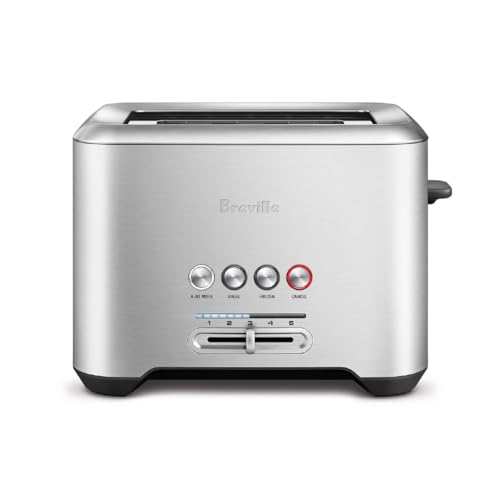
What are the best toasters right now?
Our top pick is the Breville BTA840XL Die-Cast 4-Slice Smart Toaster (top pick), because thermostatic shade control, same shade setting produces consistent results on a cold and warm toaster. The runner-up is the Cuisinart CPT-435C Countdown 4-Slice Stainless Steel Toaster, followed by the Breville BTA720XL Die-Cast 2-Slice Smart Toaster.
Is the Breville BTA840XL Die-Cast 4-Slice Smart Toaster worth it?
For most buyers, yes. It ranks #1 in our toasters research, though heavier than most toasters (5.5 lb), moving it to clean under is slightly more effort.
What makes an expensive toaster better than a $20 one?
Browning evenness is the primary quality difference. Budget toasters heat from elements that are closer together at the top and bottom than at the center, the top and bottom edges of the toast darken faster than the middle. A Breville or Cuisinart toaster uses more closely spaced elements and higher wattage to distribute heat evenly from the top to the bottom of the slot, producing uniform browning. The second difference is consistency across cycles: a budget toaster at shade 3 produces different results on a cold toast vs a warm toaster, a quality toaster uses a thermostat that compensates for the starting temperature of the element to produce consistent results on every cycle. The third difference: slot width, quality toasters have 1.5-inch slots that accommodate thick bread and bagels; budget toasters often have 1-inch slots that squeeze thick items and produce white streaks w here the bread contacted the element housing.
What is bagel mode on a toaster?
Bagel mode toasts only the inner (cut) side of the bagel and warms the outer curved side without toasting it. A bagel placed cut-side-in: standard toasting heats both sides equally, producing a crunchy exterior on a bagel that was meant to stay soft. Bagel mode (on most toasters): the inner element runs at full heat, the outer element runs at reduced heat or only provides gentle warming. The result: a toasted, crispy inner surface with a warm, soft outer crust. Implementation quality varies, some budget bagel modes are only marginally different from standard; Cuisinart and Breville bagel modes produce the correct single-side toast on most bagel thicknesses.
Are wide-slot toasters necessary?
For standard sandwich bread (3/4-inch thick): no, any slot accommodates this. For thick-cut bread (artisan sourdough, bakery slices, 1-inch thick): a 1.5-inch wide slot is required, a narrow slot squeezes the bread against the element housing and toasts unevenly. For bagels: a 1.25-inch minimum slot accommodates a standard bagel thickness. Most quality toasters (Breville, Cuisinart) include 1.5-inch wide slots.
How do I clean a toaster properly?
Remove and empty the crumb tray after every 3 to 5 uses, most quality toasters have a slide-out crumb tray at the bottom. A full crumb tray can cause uneven heating and is a fire risk. Clean the interior: unplug the toaster, hold it over the sink, and shake gently to dislodge crumbs not captured by the tray. Use a soft pastry brush to sweep the interior. Do not use water in the interior, electrical components are in the lower body near the heating element. The exterior: wipe with a slightly damp cloth; for stainless steel exteriors, wipe in the direction of the gra in to avoid scratches.
What shade setting should I use for toast?
Most toasters use a 1 to 6 or 1 to 7 shade scale. Setting 2 to 2.5: lightly golden, soft, minimal crust formation, suitable for bread intended for dipping in olive oil or for very th in slices. Setting 3 to 3.5: the standard household preference, golden brown, light crisp exterior, fully heated interior. Setting 4 to 4.5: medium-dark, firm crust, more pronounced toast flavor from caramelization, preferred for toast with butter or jam that benefits from a sturdy surface. Setting 5 to 6: dark, near-burnt in spots, preferred by a minority; useful for bagels w here maximum internal crispiness is desired. For first use: start at 3 and adjust by half-step increments on subsequent uses to find your preference.
Is a 4-slice toaster worth it over a 2-slice?
For a household of 3 or more people eating toast at the same meal: yes, a 4-slice toaster reduces batch time from two cycles (2+2) to one cycle, saving 1 to 2 minutes per person at the table. For a household of 1 to 2: the extra counter footprint of a 4-slice toaster is the ma in cost. A 4-slice toaster is approximately 50% wider than a 2-slice. If you regularly make toast for 4 people simultaneously: the 4-slice is clearly the right choice. If you make 2 slices at a time 95% of the time: the 2-slice saves meaningful counter space.