As an Amazon Associate I earn from qualifying purchases. Picks are based on manufacturer specs, independent reviews and owner reports.
Our top picks
Short on time? Our top recommendation is the Breville BOV800XL Smart Oven 1800-Watt Convection Toaster Oven.
Compare
At a glance
The traits that separate these picks, side by side.
| # | Product | Best for | Key feature | |
|---|
| 1 | | — | Element IQ, five independently controlled heating elements | Check ↗ |
| 2 | | — | 1800W with dedicated air fry setting and mesh Air Fryer Rack | Check ↗ |
| 3 | | — | 1800W with 11-in-1 functions including air fry, dehydrate, and rotisserie | Check ↗ |
| 4 | | — | 1300W with roll-top door instead of a swing-down door | Check ↗ |
| 5 | | — | 1800W with tw in heating elements and a high-speed fan | Check ↗ |
| 6 | | — | 1300W with natural convection fan | Check ↗ |
| 7 | | — | 1500W with digital controls and convection | Check ↗ |
| 8 | | — | Double infrared heating elements, no preheat required | Check ↗ |
| 9 | | — | 1500W with digital display and convection fan | Check ↗ |
| 10 | | — | 1800W with Even-Heat True Convection dual fans | Check ↗ |
| 11 | | — | 1800W with convection fan and Exact Heat sensor | Check ↗ |
| 12 | | — | 1500W with 14-in-1 preset functions including air fry and dehydrate | Check ↗ |
| 13 | | — | — | Check ↗ |
In depth
The 13 best, explained
Why each made the cut, where it falls short, and who should buy it.
Top pickBreville
It stands out for element IQ produces the most even browning of any toaster oven, edge-to-edge on a full sheet of cookies and thermostat holds with in 5 to 15 degrees of the setting, versus a 50-degree spread on budget models.
- Element IQ, five independently controlled heating elements
- 1800W convection with 8 cooking functions
- 0.8 cubic foot interior fits a 13x9 roasting pan or 12-inch pizza
- Thermostat accuracy with in 5 to 15 degrees of the set point
- Interior light for monitoring without opening the door
✓ Pros
- Element IQ produces the most even browning of any toaster oven, edge-to-edge on a full sheet of cookies
- Thermostat holds with in 5 to 15 degrees of the setting, versus a 50-degree spread on budget models
- 0.8 cubic foot cavity fits a 13x9 pan, a 12-inch pizza, or a whole 4-pound chicken
- 8 functions cover toast, bagel, bake, roast, broil, pizza, cookies, and reheat without gimmicks
✕ Cons
- No air fry function, the BOV900BSS is the air fry equivalent at a higher price
- 18.5-inch width requires a dedicated counter footprint
Cuisinart
6 cubic foot interior fits a 12-inch pizza while staying compact. Keep in mind that thermostat runs 15°F to 25°F off the set temperature, requiring manual compensation for precise baking.
- 1800W with dedicated air fry setting and mesh Air Fryer Rack
- 7 functions: air fry, convection bake, convection broil, bake, broil, warm, toast
- 0.6 cubic foot cavity fits a 12-inch pizza
- Analog dial controls with mechanical timer
- 3-year limited warranty
✓ Pros
- Genuinely crispy air fry results, roughly 85-90% as crisp as a dedicated basket air fryer
- 0.6 cubic foot interior fits a 12-inch pizza while staying compact
- 3-year warranty beats the 1-year coverage on the Breville and most competitors
✕ Cons
- Thermostat runs 15°F to 25°F off the set temperature, requiring manual compensation for precise baking
- No digital timer display in the base model, just a mechanical dial
- Smaller cavity than the Breville, so a full 9x13 pan is tight
Instant Pot
6 cubic foot cavity with included rotisserie spit and forks. Keep in mind that air fry crisping is noticeably less aggressive than the Ninja or Breville due to a lower fan speed.
- 1800W with 11-in-1 functions including air fry, dehydrate, and rotisserie
- 0.6 cubic foot cavity with included rotisserie spit and forks
- 7-inch full-color digital display
- Includes air fry basket, rotisserie kit, and 2 wire racks
- Reheat and warm functions with reduced power draw
✓ Pros
- Rotisserie kit is a genuine differentiator, no other model in this guide includes a spit and forks
- Large color display makes function and time selection more intuitive than dial-based competitors
- 11 functions replace a rotisserie, dehydrator, and toaster oven in one countertop footprint
✕ Cons
- Air fry crisping is noticeably less aggressive than the Ninja or Breville due to a lower fan speed
- Rotisserie kit adds bulk and requires storage space when not in use
- Multiple functions and a digital menu system mean a steeper learning curve than simpler models
Hamilton Beach
4 cubic foot cavity fits a 9-inch pizza. Keep in mind that no convection fan, a basic radiant-heat design, so browning is less even than convection models.
- 1300W with roll-top door instead of a swing-down door
- 4-slice / 0.4 cubic foot cavity fits a 9-inch pizza
- Toast, bake, and broil functions with analog dials
- Removable crumb tray and non-stick interior
- Auto shutoff after cook cycle completes
✓ Pros
- Roll-top door eliminates dripping grease or food sliding off a hot drop-down door
- Compact footprint fits counters w here a standard swing-door oven can't
- Simple analog controls with no learning curve for toast and reheating
✕ Cons
- No convection fan, a basic radiant-heat design, so browning is less even than convection models
- 0.4 cubic foot cavity is too small for a 12-inch pizza or a 9x13 pan
- No digital timer precision, just a mechanical dial
Ninja
Largest realistic capacity in this guide, 2 racks let a full sheet of food cook on each level at once
- 1800W with tw in heating elements and a high-speed fan
- 10-in-1 functions including air fry, air roast, dehydrate, and toast
- 2-rack simultaneous cooking, a full sheet pan on each level
- Fits a 13-inch pizza or a whole chicken
- Digital display with presets, no manual guesswork on time or temp
✓ Pros
- Largest realistic capacity in this guide, 2 racks let a full sheet of food cook on each level at once
- Fastest, crispiest air fry results in household testing thanks to a higher fan speed and tw in elements
- 10 functions cover nearly every countertop cooking task, reducing appliance clutter
- Digital presets remove the guesswork of matching time and temperature for common foods
✕ Cons
- Largest footprint in this guide, needs more counter depth than single-rack models
- Fan noise is noticeably louder than the Cuisinart or Breville during air fry cycles
- Two racks mean two trays and two crumb areas to clean after a full-capacity cook
Black+Decker
Compact 4-slice size suits a solo or couple household without wasted counter space
- 1300W with natural convection fan
- 4-slice cavity fits a 9-inch pizza
- Toast, bake, and broil functions
- 60-minute mechanical timer with stay-on setting
- Under $40 street price
✓ Pros
- Compact 4-slice size suits a solo or couple household without wasted counter space
- Reliable, straightforward dial controls for daily toast and reheating
✕ Cons
- Natural convection is functional but noticeably weaker than the forced high-speed fans on air fry models
- No digital display or precise temperature readout
- Small cavity rules out anything larger than a 9-inch pizza or a handful of muffins
Panasonic
Double infrared elements reach cooking temperature in 2 to 3 minutes versus 5 to 8 for standard elements
- Double infrared heating elements, no preheat required
- 4-slice compact cavity fits a 9-inch pizza
- Reaches cooking temperature in 2 to 3 minutes
- Toast, bake, and broil functions
- Slide-out crumb tray
✓ Pros
- Double infrared elements reach cooking temperature in 2 to 3 minutes versus 5 to 8 for standard elements
- No-preheat design saves real time on daily toast and quick reheats
- Compact size and infrared heat produce more even results than budget convection models at this size
✕ Cons
- 4-slice cavity is too small for a 12-inch pizza or family-size baking
- Infrared elements run hotter near the glass door, and the exterior gets warm to the touch
- Higher price than other compact models in this list despite the small capacity
Toshiba
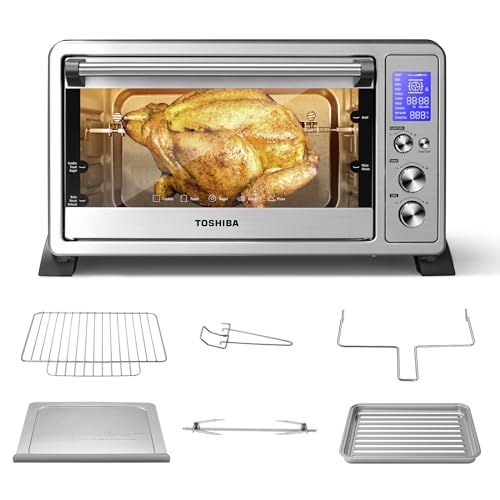
Toshiba's AC25CEW-SS is a convection toaster oven with rotisserie and digital controls.
- 1500W with digital display and convection fan
- 6-slice / 0.5 cubic foot cavity fits a 12-inch pizza
- Bake, toast, broil, warm, and convection functions
- 9 preset digital cook settings
- Interior light for monitoring without opening the door
✓ Pros
- Convection
- Rotisserie
- Digital controls
- Spacious interior
✕ Cons
- Large footprint
- Exterior heat
- Controls learning curve
KitchenAid
5 cubic foot digital countertop cavity fits a 9-inch pizza. 5 cubic foot cavity is smaller than the Cuisinart TOA-60 or Oster at similar prices.
- 1800W with Even-Heat True Convection dual fans
- 0.5 cubic foot digital countertop cavity fits a 9-inch pizza
- 9 functions including bake, broil, and warm
- Digital display with temperature probe port
- Includes bake pan and broil rack
✓ Pros
- Dual-fan Even-Heat True Convection matches Breville-level browning consistency in independent testing
- Build quality and fit-and-finish are a step above most mid-range competitors
- Temperature probe port allows precise roast monitoring, uncommon at this price point
✕ Cons
- 0.5 cubic foot cavity is smaller than the Cuisinart TOA-60 or Oster at similar prices
- No air fry function despite the premium price
- Temperature probe accessory is sold separately from the probe port
Cuisinart
8 cubic foot cavity fits a 13x9 pan or 12-inch pizza. Keep in mind that no air fry function, unlike the Cuisinart TOA-60 in the same lineup.
- 1800W with convection fan and Exact Heat sensor
- 0.8 cubic foot cavity fits a 13x9 pan or 12-inch pizza
- Exact Heat sensor monitors and corrects temperature during cooking
- 3-year limited warranty
✓ Pros
- Exact Heat sensor actively corrects oven temperature mid-cook, closing the gap with pricier Breville models
- 0.8 cubic foot interior matches the Breville BOV800XL's capacity at a lower price
- 3-year warranty exceeds the 1-year coverage on the Breville
✕ Cons
- No air fry function, unlike the Cuisinart TOA-60 in the same lineup
- Exact Heat correction is not as fast or precise as Breville's Element IQ in side-by-side testing
- Larger footprint than the TOA-60 for a similar price range
Cosori
5 cubic foot cavity fits a 9-inch pizza. 5 cubic foot cavity struggles with a 12-inch pizza or a full-size sheet pan.
- 1500W with 14-in-1 preset functions including air fry and dehydrate
- 12-quart / 0.5 cubic foot cavity fits a 9-inch pizza
- Digital touchscreen with 12 one-touch presets
- Includes non-stick air fry basket and drip pan
- Shade dial for toast darkness control
✓ Pros
- 14 presets cover more specialty functions (dehydrate, proof, ferment) than most competitors at this price
- Digital touchscreen is easier to use precisely than analog dial competitors
✕ Cons
- Smaller 0.5 cubic foot cavity struggles with a 12-inch pizza or a full-size sheet pan
- Interior light is dim, making it hard to check food without opening the door
- Build materials feel noticeably lighter-duty than the Breville or Cuisinart TOB-135N
Ninja
An 8-in-1 countertop oven that flips up against the backsplash to free counter space.
✓ Pros
- Flips up for storage
- Air fry, bake, toast and more
- Fits a 12-inch pizza
- Fast heating
✕ Cons
- Low interior height limits tall foods
- Exterior gets hot
- Flip mechanism needs backsplash clearance
How we chose these picks
This shortlist is the product of research, not advertising. We cross-checked manufacturer specs against independent reviews and long-term owner feedback, then ranked by value for real use cases.
Mistakes buyers often make
- Choosing the cheapest option without checking warranty and support quality.
- Assuming all models work with your existing setup, verify compatibility first.
- Skipping the measurements: returns most often come from fit surprises.
- Chasing the newest release when last year's model does the same job for less.
How to choose: the factors that matter
Capacity first: measure what you regularly cook and match the cavity size.
A 6-inch frozen pizza fits a compact model; a 12-inch pizza needs a 6-slice or larger.
Convection matters: all the models above include convection (a fan that circulates hot air).
Models without convection produce noticeably less even results.
Air fry: if you want the function, buy a model with a dedicated air fry setting and a mesh basket or raised rack.
The bottom line
If you want the short answer: the top pick above suits most buyers, the value pick suits tight budgets, and the specialist picks suit specific needs. Match the pick to your use case, not to the hype.
FAQ
Common questions
What are the best toaster ovens right now?
Our top pick is the Breville BOV800XL Smart Oven 1800-Watt Convection Toaster Oven (top pick), because element IQ produces the most even browning of any toaster oven, edge-to-edge on a full sheet of cookies. The runner-up is the Cuisinart TOA-60 Air Fryer Toaster Oven, followed by the Instant Pot Omni Plus 11-in-1 Toaster Oven.
Is the Breville BOV800XL Smart Oven 1800-Watt Convection Toaster Oven worth it?
For most buyers, yes. It ranks #1 in our toaster ovens research, though no air fry function, the BOV900BSS is the air fry equivalent at a higher price.
What is the difference between a toaster oven and an air fryer?
A toaster oven with an air fry function and a standalone air fryer accomplish similar results through the same mechanism: a heating element plus a high-speed fan that circulates hot air to crisp food without submerging it in oil. The differences: standalone air fryers have a basket design that allows airflow under the food, which produces slightly crispier results on foods like french fries. Toaster ovens with air fry have a rack and a tray below, adequate for most foods, but the basket geometry is not identical. Toaster ovens are more versatile (bake, broil, toast, roast, air fry in one appliance). Standalone air fryers are smaller and faster to heat up for a single function. For kitchens with limited counter space that want both functions: a toaster oven with air fry is the more efficient use of space.
What size toaster oven do I need?
2-slice equivalent (small): accommodates toast, reheating single portions, small pizzas. For solo or minimal cooking. 4-slice / compact: adds baking a half-dozen muffins, a 9-inch frozen pizza, or a small casserole. Most common size for couples. 6-slice / large: fits a whole rotisserie chicken, a 12-inch pizza, or a 9x13 baking pan. For families or those replacing a ma in oven for smaller tasks. 12-slice / extra-large: fits a 13x9 roasting pan, two racks of food, or a 12-pound turkey. For serious cooks replacing a second oven. Measure your counter space before purchasing, toaster ovens range from 12 inches wide (2-slice) to 20 inches wide (12-slice) and require 4 inches of clearance on all sides.
Do more expensive toaster ovens cook better?
For reheating and toast: budget is fine. For actual baking with temperature-sensitive recipes: the precision of a Breville or Cuisinart is worth the cost.
Can a toaster oven replace a regular oven?
For everyday tasks: yes, a 6-slice or larger model handles most single-meal baking, roasting, and broiling. Limitations: capacity (cannot fit a full Thanksgiving turkey or a large lasagna without a 12-slice model), and consistency (most toaster ovens have slight hot spots that matter for a full rack of cookies but not for a single casserole). For supplement or replacement for two-person and smaller households: a well-chosen large toaster oven covers 80 to 90% of oven tasks with faster preheat times (5 to 8 minutes vs 15 to 20 for a standard range) and lower energy use. For households with frequent large-batch cooking: a toaster oven supplements the ma in oven rather than replacing it.
What is Element IQ in Breville toaster ovens?
Element IQ is Breville's name for their independently controlled heating elements, each element can be set to different power levels for different cooking functions. On a standard toaster oven: all top elements run at the same power and all bottom elements at the same power. On a Breville with Element IQ: the front and rear elements can run at different intensities, so heat concentration can be shifted toward the center of the oven (for baking), toward the top front (for broiling), or toward the back (for convection). The practical result: more even browning, more accurate temperature, and better function-specific performance than fixed-element models.
Keep researching
Related guides & comparisons