As an Amazon Associate I earn from qualifying purchases. Picks are based on manufacturer specs, independent reviews and owner reports.
Our top picks
Short on time? Our top recommendation is the Zojirushi NS-TSC10 Micom Rice Cooker.
Compare
At a glance
The traits that separate these picks, side by side.
| # | Product | Best for | Key feature | |
|---|
| 1 | | — | Fuzzy logic (Micom) microcomputer | Check ↗ |
| 2 | | — | Fuzzy logic temperature control | Check ↗ |
| 3 | | — | Panasonic fuzzy logic | Check ↗ |
| 4 | | — | 8-cup uncooked capacity | Check ↗ |
| 5 | | — | 20-cup cooked capacity | Check ↗ |
| 6 | | — | 3-cup uncooked capacity | Check ↗ |
| 7 | | — | Tiger MICOM fuzzy logic | Check ↗ |
| 8 | | — | 20-cup cooked capacity | Check ↗ |
| 9 | | — | 10-cup uncooked capacity | Check ↗ |
| 10 | | — | 3-cup uncooked capacity | Check ↗ |
In depth
The 10 best, explained
Why each made the cut, where it falls short, and who should buy it.
Zojirushi
Zojirushi's inner pot coating outlasts the non-stick aluminum used in budget models
- Fuzzy logic (Micom) microcomputer
- 5.5-cup uncooked capacity
- Nonstick spherical inner pot
- Retractable cord
- White, sushi, brown, and quick-cook settings
- Keep-warm past 6 hours without yellowing
✓ Pros
- Zojirushi's inner pot coating outlasts the non-stick aluminum used in budget models
- Keep-warm quality noticeably better than basic thermostat cookers at the 4 to 6 hour mark
- Retractable cord and detachable lid simplify storage and cleaning
✕ Cons
- 5.5-cup capacity is modest for large families compared to 10-cup budget models
- No induction heating or pressure cooking at this price tier
Toshiba
Fuzzy logic at a price point w here competitors only offer single-thermostat control
- Fuzzy logic temperature control
- 6-cup uncooked capacity
- Stainless steel inner lid
- White, brown, and quick-cook settings
- 24-hour keep-warm timer
- LCD display with cook-time countdown
✓ Pros
- Fuzzy logic at a price point w here competitors only offer single-thermostat control
- 6-cup capacity handles a household of 4 without stepping up in price
- LCD countdown display removes guesswork on remaining cook time
✕ Cons
- Brown rice results are noticeably less consistent than Zojirushi's fuzzy logic
- Plastic body and controls feel less durable than the metal-accented Zojirushi
- Shorter track record and smaller review base than the established Japanese brands
Panasonic
10-cup capacity is nearly double the Zojirushi NS-TSC10 at a lower price
- Panasonic fuzzy logic
- 10-cup uncooked capacity
- Diamond-fluorine coated inner pot
- Brown rice and porridge settings
- Extended keep-warm
- Retractable cord
✓ Pros
- 10-cup capacity is nearly double the Zojirushi NS-TSC10 at a lower price
- Diamond-fluorine coating resists scratching better than standard non-stick
✕ Cons
- Less widely distributed in the US, making parts and support harder to find
- Brown rice consistency trails the Zojirushi at large fill levels
- Bulkier footprint than the 5.5-cup models given the 10-cup capacity
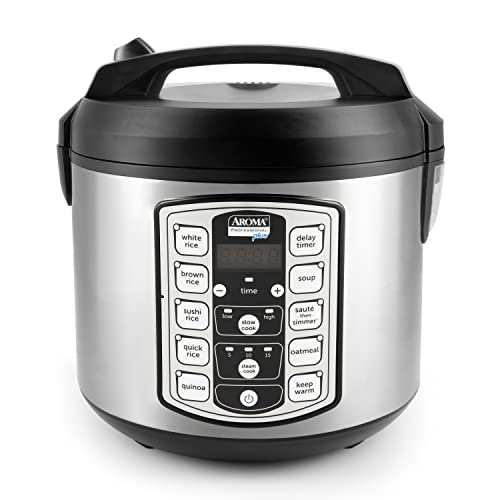
Aroma
Highest-volume budget rice cooker on the market with a large, established review base
- 8-cup uncooked capacity
- Single-thermostat cook/warm switch
- Digital display
- Included steam tray
- Nonstick aluminum inner pot
- Cool-touch handles
✓ Pros
- Highest-volume budget rice cooker on the market with a large, established review base
- 8-cup capacity covers family use at a fraction of a fuzzy logic model's price
- Digital display and steam tray are uncommon extras at this price point
✕ Cons
- Single-thermostat control means no adjustment for brown rice or specialty grains
- Inconsistent results at maximum 8-cup fill level
- Non-stick coating typically wears with in 1 to 3 years of daily use
Hamilton Beach
The highlights are 20-cup cooked capacity serves large families or gatherings at a budget price and removable inner pot and glass lid simplify cleanup and monitoring. Keep in mind that basic thermostat produces uneven results at or near maximum capacity.
- 20-cup cooked capacity
- Single-thermostat cook/warm switch
- Nonstick removable inner pot
- See-through glass lid
- Steam tray included
- Rice scoop and measuring cup included
✓ Pros
- 20-cup cooked capacity serves large families or gatherings at a budget price
- Removable inner pot and glass lid simplify cleanup and monitoring
- Included accessories (scoop, tray, measuring cup) add value at this price
✕ Cons
- Basic thermostat produces uneven results at or near maximum capacity
- No brown rice or specialty settings
- Larger footprint takes up significant counter space
Zojirushi
The highlights are zojirushi reliability and inner pot quality in a compact 3-cup size and steaming basket adds vegetable and fish steaming without a separate appliance. Keep in mind that no fuzzy logic, single-thermostat control like budget brands.
- 3-cup uncooked capacity
- Simple cook/steam/warm switch
- Nonstick inner pot
- Includes steaming basket
- Compact 7 to 8-inch footprint
- Zojirushi build quality
✓ Pros
- Zojirushi reliability and inner pot quality in a compact 3-cup size
- Steaming basket adds vegetable and fish steaming without a separate appliance
- Small footprint suits dorm rooms and studio kitchens
✕ Cons
- No fuzzy logic, single-thermostat control like budget brands
- 3-cup ceiling means two cycles for larger households
- Priced closer to fuzzy logic competitors despite basic thermostat control
Tiger
5-cup uncooked capacity. Keep in mind that tiger's gra in texture runs slightly firmer than Zojirushi, a preference-dependent tradeoff.
- Tiger MICOM fuzzy logic
- 5.5-cup uncooked capacity
- Tacook synchro-cooking plate
- White, brown, sushi, and porridge settings
- Retractable cord
- Nonstick inner pot
✓ Pros
- Tacook plate lets you steam a prote in above the rice while it cooks simultaneously
- Tiger MICOM fuzzy logic brings brown rice and sushi settings competitive with Zojirushi
- Retractable cord and nonstick pot match Zojirushi's convenience features
✕ Cons
- Tiger's gra in texture runs slightly firmer than Zojirushi, a preference-dependent tradeoff
- Fewer menu settings than Zojirushi's Neuro Fuzzy line
- Smaller US review base and service network than Zojirushi
Aroma
Digital delay timer at a budget price point most single-thermostat cookers lack
- 20-cup cooked capacity
- Digital display with delay timer
- Nonstick removable inner pot
- Steam tray included
- Single-thermostat cook/warm control
- Cool-touch exterior
✓ Pros
- Digital delay timer at a budget price point most single-thermostat cookers lack
- 20-cup capacity handles large batches or events without stepping up in price
- Removable inner pot simplifies cleanup versus fixed-pot competitors
✕ Cons
- No fuzzy logic, so brown rice and specialty grains cook inconsistently
- Large footprint requires significant counter or storage space
- Build quality feels less substantial than Zojirushi or Tiger at nearly the same size
Cosori
10-cup capacity with digital presets undercuts comparable Zojirushi and Panasonic pricing
- 10-cup uncooked capacity
- Digital one-touch presets
- Nonstick ceramic-coated inner pot
- White, brown, mixed, and steam settings
- 24-hour keep-warm
- App connectivity (select models)
✓ Pros
- 10-cup capacity with digital presets undercuts comparable Zojirushi and Panasonic pricing
- Ceramic-coated pot avoids the PTFE non-stick used in cheaper budget cookers
- Preset menu covers brown rice and mixed grains without manual timing
✕ Cons
- Newer brand in the category with a shorter track record than the Japanese and Korean incumbents
- Brown rice results are adequate but not as consistent as dedicated fuzzy logic algorithms
- Larger 10-cup body takes more counter space than 5.5-cup mid-range models
Black+Decker
The highlights are lowest price in this roundup for a functional, reliable rice cooker and compact 3-cup size fits small kitchens and dorm setups. Keep in mind that single-thermostat design cannot handle brown rice consistently.
- 3-cup uncooked capacity
- Single cook/warm switch
- Nonstick removable bowl
- Tempered glass lid
- Compact, lightweight body
- Rice measuring cup and spoon included
✓ Pros
- Lowest price in this roundup for a functional, reliable rice cooker
- Compact 3-cup size fits small kitchens and dorm setups
- Simple one-switch operation with no learning curve
✕ Cons
- Single-thermostat design cannot handle brown rice consistently
- 3-cup ceiling is too small for households of 3 or more
- Non-stick coating and switch mechanism tend to wear with in 1 to 2 years of daily use
How we chose these picks
Every pick below earned its place through documented strengths, verified specifications, consistent praise in reputable reviews, and owner-feedback patterns. We don't sell placements, and we don't invent test scores.
Mistakes buyers often make
- Choosing the cheapest option without checking warranty and support quality.
- Assuming all models work with your existing setup, verify compatibility first.
- Skipping the measurements: returns most often come from fit surprises.
- Chasing the newest release when last year's model does the same job for less.
How to choose: the factors that matter
- Capacity and sizing — Measure your space and your actual use before falling for bigger-is-better. The right size is the one that fits your routine, not the spec sheet's maximum.
- Build quality and materials — Heavier-gauge materials, tight tolerances, and solid joints outlast thin, rattly construction. In reviews, look for longevity comments over first-impression praise.
- Ease of use and setup — Clear instructions, intuitive controls, and minimal assembly separate daily drivers from garage ornaments.
- Maintenance and cleaning — Whatever you buy will need cleaning. Removable, dishwasher-safe, or wipe-clean parts get maintained; fiddly ones get neglected.
- Warranty and support — A multi-year warranty signals the manufacturer expects it to last. Check what's actually covered, motors and frames matter more than accessories.
The bottom line
There's no single 'best' here, only the best match for your situation. Start from your must-have features, then choose the least expensive pick that covers them.
FAQ
Common questions
What are the best rice cookers under $100 right now?
Our top pick is the Zojirushi NS-TSC10 Micom Rice Cooker (our top pick), because zojirushi's inner pot coating outlasts the non-stick aluminum used in budget models. The runner-up is the Toshiba Rice Cooker with Fuzzy Logic TRCS01, followed by the Panasonic SR-DF181 10-Cup Fuzzy Logic Rice Cooker.
Is the Zojirushi NS-TSC10 Micom Rice Cooker worth it?
For most buyers, yes. It ranks #1 in our rice cookers under $100 research, though 5.5-cup capacity is modest for large families compared to 10-cup budget models.
Is a $25 rice cooker good enough?
For white rice as the only use: yes, with some caveats. The failure modes: inconsistent results at maximum capacity, difficulty with brown rice, shorter lifespan than mid-range models (1 to 3 years of daily use vs 3 to 5 years for Zojirushi mid-range).
What does fuzzy logic do in a rice cooker?
Fuzzy logic adds a microprocessor that monitors temperature and cooking time during the cycle and adjusts heat output based on those readings. Standard rice cookers measure only when the temperature rises above boiling (indicating water has evaporated) and switch to warm at that point. Fuzzy logic cookers adjust cooking time and temperature based on the rice variety selection, brown rice gets a longer, different temperature curve than white rice; sushi rice gets a specific temperature cycle for correct stickiness. The result: more consistent results across rice types and at different fill levels.
Can I cook brown rice in a basic rice cooker?
You can, but the results are inconsistent. Brown rice requires approximately 2.5 times its volume in water (vs 1.5 to 2 times for white rice) and longer cooking time. A basic rice cooker's single thermostat switches to warm when it detects the temperature rise indicating water depletion, for brown rice, this often happens before the gra in is fully cooked through. The result: brown rice with a firm, undercooked center and properly cooked exterior. Fix with a basic cooker: use a 1:2.5 rice-to-water ratio and use the extended cook time by pressing the cook button a second time after the first cycle completes. With a fuzzy logic cooker: select the brown rice setting and the cooker handles the cycle automatically.
Does the inner pot material matter?
Yes, the inner pot coating affects both rice quality and durability. Standard non-stick aluminum: common in budget models, adequate for white rice, wears after 1 to 3 years of daily use (coating peeling is a sign of end-of-life). Hard-anodized aluminum: more durable, commonly used in Tiger and Cuckoo mid-range. Stainless steel: durable, no coating to wear, but rice sticks more than non-stick (requires soaking before washing). Ceramic or multilayer non-stick (Zojirushi premium): most durable coating, excellent heat distribution, longest lifespan.
Keep researching
Related guides & comparisons