As an Amazon Associate I earn from qualifying purchases. Picks are based on manufacturer specs, independent reviews and owner reports.
Our top picks
Short on time? Our top recommendation is the Freud 75-100 Up Spiral Bit, 1/8-Inch.
Compare
At a glance
The traits that separate these picks, side by side.
In depth
The 8 best, explained
Why each made the cut, where it falls short, and who should buy it.
Best OverallFreud
Center-cutting end allows plunging directly into the surface without a pilot hole
- Spiral up-cut geometry
- Center-cutting end
- TiCo carbide
- 1/4-inch shank
✓ Pros
- Center-cutting end allows plunging directly into the surface without a pilot hole
- Spiral up-cut geometry produces a shearing action that dramatically reduces tearout
- TiCo carbide stays sharp longer than standard carbide in repeated plunge cuts
- The most commonly recommended plunge bit for stopped grooves and mortises
✕ Cons
- Up-cut spiral pulls chips upward -- some chip ejection onto the workpiece surface
- Higher price than standard straight plunge bits
Best Down CutFreud
Down-cut spiral pushes chips downward into the kerf -- keeps the workpiece surface clean
- Down-cut spiral
- Pushes chips into the cut
- TiCo Hi-Density carbide
- Clean top surface
✓ Pros
- Down-cut spiral pushes chips downward into the kerf -- keeps the workpiece surface clean
- The correct choice for plunge cuts in veneered plywood and laminate w here the top surface is visible
- TiCo carbide construction for strong edge retention
- Clean, crisp entry on the top face that an up-cut bit cannot match
✕ Cons
- Down-cut geometry is less efficient at chip removal -- more heat in the cut
- Higher price than a comparable up-cut bit
- Not ideal for deep cuts due to chip packing
Best Quarter InchFreud
A common everyday diameter for stopped grooves and shallow mortises
- 1/4-inch diameter
- Center-cutting
- TiCo Hi-Density carbide
- 1/4-inch shank
✓ Pros
- A common everyday diameter for stopped grooves and shallow mortises
- TiCo carbide for strong edge retention in repeated plunge cuts
- Sized for handheld routing w here a compact bit is easier to control
- A practical companion size alongside the 1/8-inch bit for a range of groove widths
✕ Cons
- Single fixed diameter -- doesn't cover wider mortises
Best SetYonico
Set provides multiple plunge bit sizes in one purchase for the price of a single premium bit
- Multiple sizes in set
- Up-cut spiral
- Center-cutting
- Budget price
✓ Pros
- Set provides multiple plunge bit sizes in one purchase for the price of a single premium bit
- Good starting set for new woodworkers learning mortising and stopped-groove routing
- Yonico carbide is adequate for softwood and plywood
- Center-cutting geometry on all bits in the set
✕ Cons
- Yonico carbide dulls faster than Freud or Amana in hardwood
- Cut quality is lower than premium bits -- more tearout in hardwood
Best Straight PlungeCMT
Straight flutes are the correct choice for plunge cuts in inlay recesses w here parallel walls matter
- Center-cutting straight bit
- Two-flute design
- Micro-gra in carbide
- Anti-kickback body
✓ Pros
- Straight flutes are the correct choice for plunge cuts in inlay recesses w here parallel walls matter
- Anti-kickback body reduces the risk of catches when starting a plunge cut
- CMT micro-gra in carbide provides better edge retention than standard carbide
- Flat bottom makes it correct for hinge mortises and shallow recesses
✕ Cons
- Straight flutes produce more tearout than spiral geometry in many hardwoods
- Anti-kickback limits feed rate
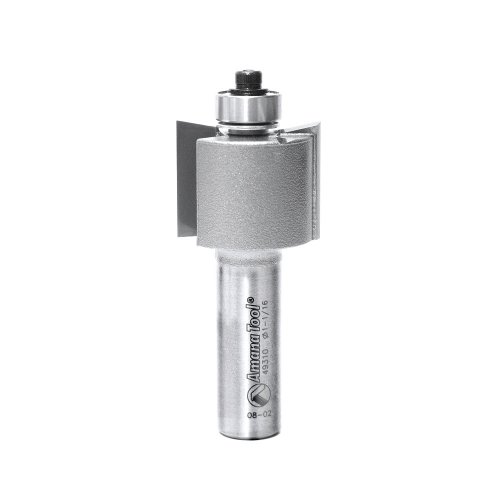
Best Flat BottomAmana
Amana carbide is harder than standard carbide and holds an edge through repeated plunge cuts
- Center-cutting
- Carbide-tipped
- Flat bottom
- 1/2-inch shank
✓ Pros
- Amana carbide is harder than standard carbide and holds an edge through repeated plunge cuts
- Center-cutting capability for direct plunge without pilot hole
- Flat bottom for accurate recess depth
- A distinct special-rabbet profile useful for stepped hardware mortises
✕ Cons
- Straight geometry -- more tearout than spiral in difficult grain
- 1/2-inch shank required
Best Mortising BitFreud
Keep in mind that single fixed width -- buy additional bits for other tenon thicknesses.
- 3/4-inch mortising bit
- Perma-SHIELD coating
- TiCo carbide
- For mortise and tenon joints
✓ Pros
- Purpose-built for mortise routing -- the most common plunge routing application
- 3/4-inch width matches common tenon thicknesses in furniture-scale joinery
- TiCo carbide produces clean mortise walls without tearout in most hardwoods
- Perma-SHIELD coating reduces friction and pitch buildup during repeated plunge cuts
✕ Cons
- Single fixed width -- buy additional bits for other tenon thicknesses
- Mortise-specific -- less versatile than a general spiral plunge bit
Best CompressionFreud
Compression spiral is both up-cut at the bottom (clean floor) and down-cut at the top (clean surface) simultaneously
- Compression spiral geometry
- Up-cut at bottom, down-cut at top
- TiCo Hi-Density carbide
- For CNC and plunge routing
✓ Pros
- Compression spiral is both up-cut at the bottom (clean floor) and down-cut at the top (clean surface) simultaneously
- Produces clean cuts on both faces of a panel -- correct for veneered plywood routed on a CNC or with a plunge router
- TiCo Hi-Density carbide with Black I.C.E. coating for extended tool life
- Eliminates the need to choose between up-cut and down-cut when both faces are critical
✕ Cons
- Higher price than a single-direction spiral bit
- Primarily a CNC-oriented bit -- requires consistent feed rate for best performance
- Less common in hand-held plunge routing
How we chose these picks
This shortlist is the product of research, not advertising. We cross-checked manufacturer specs against independent reviews and long-term owner feedback, then ranked by value for real use cases.
Mistakes buyers often make
- Choosing the cheapest option without checking warranty and support quality.
- Assuming all models work with your existing setup, verify compatibility first.
- Skipping the measurements: returns most often come from fit surprises.
- Chasing the newest release when last year's model does the same job for less.
How to choose: the factors that matter
- Capacity and sizing — Measure your space and your actual use before falling for bigger-is-better. The right size is the one that fits your routine, not the spec sheet's maximum.
- Build quality and materials — Heavier-gauge materials, tight tolerances, and solid joints outlast thin, rattly construction. In reviews, look for longevity comments over first-impression praise.
- Ease of use and setup — Clear instructions, intuitive controls, and minimal assembly separate daily drivers from garage ornaments.
- Maintenance and cleaning — Whatever you buy will need cleaning. Removable, dishwasher-safe, or wipe-clean parts get maintained; fiddly ones get neglected.
- Warranty and support — A multi-year warranty signals the manufacturer expects it to last. Check what's actually covered, motors and frames matter more than accessories.
The bottom line
There's no single 'best' here, only the best match for your situation. Start from your must-have features, then choose the least expensive pick that covers them.
FAQ
Common questions
What are the best plunge router bits 2026 right now?
Our top pick is the Freud 75-100 Up Spiral Bit, 1/8-Inch (best overall), because center-cutting end allows plunging directly into the surface without a pilot hole. The runner-up is the Freud 76-102 Down Spiral Bit, 1/4-Inch (best down cut), followed by the Freud 75-103 Up Spiral Bit, 1/4-Inch.
Which of the plunge router bits 2026 should I buy?
It depends on what matters most to you. For overall, choose the Freud 75-100 Up Spiral Bit, 1/8-Inch. For down cut, choose the Freud 76-102 Down Spiral Bit, 1/4-Inch. For quarter inch, choose the Freud 75-103 Up Spiral Bit, 1/4-Inch. For set, choose the YONICO 14320 CNC End Mill Solid Carbide Up Cut Set, 3 Bit.
Is the Freud 75-100 Up Spiral Bit, 1/8-Inch worth it?
For most buyers, yes. It ranks #1 in our plunge router bits 2026 research, though up-cut spiral pulls chips upward -- some chip ejection onto the workpiece surface.
Keep researching
Related guides & comparisons