As an Amazon Associate I earn from qualifying purchases. Picks are based on manufacturer specs, independent reviews and owner reports.
Our top picks
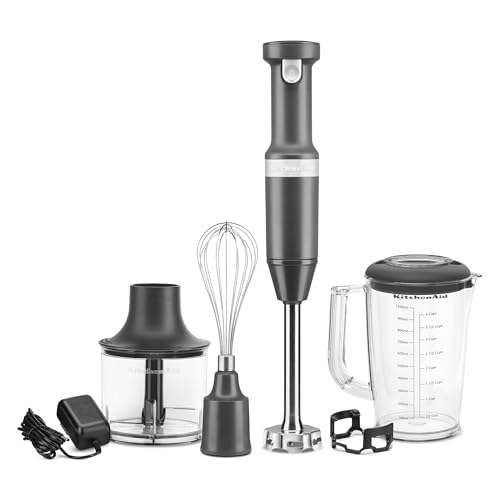
Short on time? Our top recommendation is the KitchenAid Cordless Variable Speed Hand Blender KHBBV83.
Compare
At a glance
The traits that separate these picks, side by side.
| # | Product | Best for | Key feature | |
|---|
| 1 | | — | Rechargeable lithium-ion battery, 20+ minutes of run time per charge | Check ↗ |
| 2 | | — | Rechargeable battery rated for approximately 15 minutes of continuous use | Check ↗ |
| 3 | | — | Rechargeable battery, roughly 15-20 uses per full charge | Check ↗ |
| 4 | | — | Rechargeable battery with roughly a week of standard use per charge | Check ↗ |
| 5 | | — | Rechargeable battery, roughly 15 minutes of continuous run time | Check ↗ |
| 6 | | — | Rechargeable lithium-ion battery | Check ↗ |
| 7 | | — | Rechargeable via USB-C, roughly 15 blends per charge | Check ↗ |
| 8 | | — | Rechargeable lithium-ion battery | Check ↗ |
| 9 | | — | Rechargeable battery, roughly 15-20 uses per full charge | Check ↗ |
| 10 | | — | Rechargeable via USB, roughly 10-12 blends per charge | Check ↗ |
In depth
The 10 best, explained
Why each made the cut, where it falls short, and who should buy it.
KitchenAid
It stands out for 20+ minutes of continuous blending per charge covers a full week of typical soup and sauce sessions and variable speed dial gives more control than the single-button cordless competitors.
- Rechargeable lithium-ion battery, 20+ minutes of run time per charge
- Variable speed control via twist dial on the base
- Includes whisk and chopper attachments plus a blending jar
- Stainless steel blending shaft, dishwasher-safe
- USB charging cradle with LED charge indicator
✓ Pros
- 20+ minutes of continuous blending per charge covers a full week of typical soup and sauce sessions
- Variable speed dial gives more control than the single-button cordless competitors
- Whisk and chopper attachments included, matching corded KitchenAid kits at this price
- Stainless shaft and blade guard are dishwasher-safe, unlike several rivals that require hand washing
- KitchenAid build quality carries over from the corded lineup, no wobble at the shaft connection
✕ Cons
- Battery is not user-replaceable, capacity fade after 2+ years means eventual full-unit replacement
- Charging cradle takes up counter or drawer space that a corded model doesn't require
KitchenAid
It stands out for contoured handle reduces hand fatigue noticeably during extended blending sessions and variable speed control matches the flagship KHBBV83 at a lower price. The tradeoff: no whisk or chopper attachments included, unlike the step-up KHBBV83.
- Rechargeable battery rated for approximately 15 minutes of continuous use
- Variable speed control
- Contoured soft-grip handle
- Stainless steel blending shaft
- Charging base included
✓ Pros
- Contoured handle reduces hand fatigue noticeably during extended blending sessions
- Variable speed control matches the flagship KHBBV83 at a lower price
- Lighter overall weight than the KHBBV83 makes one-handed use over a pot more comfortable
- KitchenAid stainless shaft quality without the top-tier price
✕ Cons
- No whisk or chopper attachments included, unlike the step-up KHBBV83
- 15-minute run time is shorter than the flagship model, requiring more frequent charging for heavy users
- Battery capacity is not user-replaceable
OVENTE
Best-selling cordless immersion blender in the category by rating count, reflecting broad real-world reliability
- Rechargeable battery, roughly 15-20 uses per full charge
- Single-speed operation with on/off trigger
- Stainless steel blending shaft
- USB-C charging cable included
- Compact, lightweight body under 1 pound
✓ Pros
- Best-selling cordless immersion blender in the category by rating count, reflecting broad real-world reliability
- Handles standard soups and sauces without complaint despite the low price
- USB-C charging means no proprietary cable to lose
✕ Cons
- Single speed only, no low setting for delicate finishing tasks
- Battery capacity is noticeably shorter than the KitchenAid models, needing recharge after a few days of daily use
- Plastic body feels less durable than the KitchenAid or Cuisinart competitors
OVENTE
It stands out for priced below the OVENTE HR995B while offering comparable battery and blending performance and detachable shaft simplifies cleaning compared to fixed-shaft budget models. The tradeoff: single speed only, no variable control.
- Rechargeable battery with roughly a week of standard use per charge
- Single-speed trigger operation
- Stainless steel shaft, detachable for cleaning
- USB charging cable included
- Compact, lightweight design
✓ Pros
- Priced below the OVENTE HR995B while offering comparable battery and blending performance
- Detachable shaft simplifies cleaning compared to fixed-shaft budget models
- Handles standard cooked soups and sauces reliably
✕ Cons
- Single speed only, no variable control
- Fewer ratings than the HR995B, so real-world durability data is thinner
- Battery is not user-replaceable
KitchenAid
It stands out for variable speed trigger switch is a rare feature at this price point in a cordless model and 3-cup blending jar is included, adding smoothie and dressing versatility. The tradeoff: 15-minute run time is on the shorter end for the price.
- Rechargeable battery, roughly 15 minutes of continuous run time
- Variable speed trigger switch
- Includes a 3-cup blending jar
- Stainless steel shaft
- Compact charging base
✓ Pros
- Variable speed trigger switch is a rare feature at this price point in a cordless model
- 3-cup blending jar is included, adding smoothie and dressing versatility
- KitchenAid build quality and shaft fit carry over from the corded lineup
✕ Cons
- 15-minute run time is on the shorter end for the price
- No whisk or chopper attachment included, unlike the flagship KHBBV83
Cuisinart
It stands out for two-speed control gives more flexibility than the single-speed OVENTE competitors and cuisinart brand reliability at a price close to the budget OVENTE models. The tradeoff: battery run time is shorter than the KitchenAid cordless models.
- Rechargeable lithium-ion battery
- Two-speed operation
- Stainless steel blending shaft
- USB charging cable
- Compact, lightweight body
✓ Pros
- Two-speed control gives more flexibility than the single-speed OVENTE competitors
- Cuisinart brand reliability at a price close to the budget OVENTE models
- Stainless shaft handles standard soup and sauce tasks well
✕ Cons
- Battery run time is shorter than the KitchenAid cordless models
- No included attachments (whisk, chopper, beaker)
- Charging cable is proprietary rather than USB-C
Ninja
Purpose-built for single-serve smoothies rather than adapted from a stick-blender design
- Rechargeable via USB-C, roughly 15 blends per charge
- 18-oz personal blending cup with travel lid included
- One-touch blend button
- Self-cleaning cycle with water and soap
- Compact enough for a bag or car cupholder
✓ Pros
- Purpose-built for single-serve smoothies rather than adapted from a stick-blender design
- Self-cleaning cycle is genuinely convenient for daily smoothie use
- 18-oz cup with travel lid doubles as an on-the-go container
✕ Cons
- Not a true immersion blender, cannot be used directly in a pot of soup
- Limited to the included cup size; no jar or bowl option for larger batches
- USB-C charging is slower than a dedicated charging dock
Cuisinart
Nearly identical performance to the RHB-100 at a slightly lower typical price
- Rechargeable lithium-ion battery
- Two-speed operation
- Stainless steel blending shaft
- USB charging cable
- Compact, lightweight body
✓ Pros
- Nearly identical performance to the RHB-100 at a slightly lower typical price
- Two-speed control and stainless shaft handle standard soup and sauce tasks well
- Cuisinart brand reliability
✕ Cons
- Fewer ratings than the original RHB-100, offering less real-world data
- Battery run time trails the KitchenAid cordless lineup
- No included attachments
OVENTE
It stands out for nearly identical to the HR781W at a similar price, giving buyers a color/style choice and detachable shaft simplifies cleaning.
- Rechargeable battery, roughly 15-20 uses per full charge
- Single-speed operation with on/off trigger
- Stainless steel blending shaft
- USB-C charging cable included
- Compact, lightweight body under 1 pound
✓ Pros
- Nearly identical to the HR781W at a similar price, giving buyers a color/style choice
- Detachable shaft simplifies cleaning
- Handles standard cooked soups and sauces reliably
✕ Cons
- Fewest ratings of the OVENTE lineup here, so durability track record is thinner
- Battery is not user-replaceable
Hamilton Beach
Lowest price point in the cordless roundup while still being genuinely rechargeable
- Rechargeable via USB, roughly 10-12 blends per charge
- 14-oz personal blending cup included
- One-touch blend button
- Compact, travel-friendly size
- Dishwasher-safe blending cup
✓ Pros
- Lowest price point in the cordless roundup while still being genuinely rechargeable
- Compact size makes it easy to store in a small kitchen or take on the road
- Hamilton Beach reliability at a near-entry-level price
✕ Cons
- Shortest run time per charge of any modelhere
- Not a true immersion blender, limited to its included personal cup
- Motor is noticeably weaker than the KitchenAid or Cuisinart options for anything beyond soft fruit
How we chose these picks
Every pick below earned its place through documented strengths, verified specifications, consistent praise in reputable reviews, and owner-feedback patterns. We don't sell placements, and we don't invent test scores.
Mistakes buyers often make
- Buying on brand name alone instead of matching features to your actual use case.
- Overpaying for headline specs you'll never use, define must-haves first.
- Ignoring size — compatibility, and ongoing costs (filters, accessories, refills).
- Trusting star ratings without reading what owners compla in about after 6 months.
How to choose: the factors that matter
- Capacity and sizing — Measure your space and your actual use before falling for bigger-is-better. The right size is the one that fits your routine, not the spec sheet's maximum.
- Build quality and materials — Heavier-gauge materials, tight tolerances, and solid joints outlast thin, rattly construction. In reviews, look for longevity comments over first-impression praise.
- Ease of use and setup — Clear instructions, intuitive controls, and minimal assembly separate daily drivers from garage ornaments.
- Maintenance and cleaning — Whatever you buy will need cleaning. Removable, dishwasher-safe, or wipe-clean parts get maintained; fiddly ones get neglected.
- Warranty and support — A multi-year warranty signals the manufacturer expects it to last. Check what's actually covered, motors and frames matter more than accessories.
The bottom line
If you want the short answer: the top pick above suits most buyers, the value pick suits tight budgets, and the specialist picks suit specific needs. Match the pick to your use case, not to the hype.
FAQ
Common questions
What are the best cordless immersion blenders right now?
Our top pick is the KitchenAid Cordless Variable Speed Hand Blender KHBBV83 (our top pick), because 20+ minutes of continuous blending per charge covers a full week of typical soup and sauce sessions. The runner-up is the KitchenAid Cordless Variable Speed Hand Blender KHBBV53, followed by the OVENTE Cordless Immersion Hand Blender HR995B.
Is the KitchenAid Cordless Variable Speed Hand Blender KHBBV83 worth it?
For most buyers, yes. It ranks #1 in our cordless immersion blenders research, though battery is not user-replaceable, capacity fade after 2+ years means eventual full-unit replacement.
How long does a cordless immersion blender battery last?
Most cordless immersion blenders run 15 to 25 minutes of blending time per charge, which typically equals 20 to 40 separate uses of 30 to 60 seconds each. The KitchenAid Go Cordless is rated for longer run time than budget models. Battery capacity decreases after 300 to 500 charge cycles (roughly 1 to 2 years of daily use), and most cordless immersion blenders have non-replaceable batteries. For daily heavy use: a corded model is more practical long-term. For occasional use: battery capacity is rarely the limiting factor.
Is a cordless immersion blender as powerful as a corded one?
At the same price point: no. Battery-powered motors deliver less continuous wattage than direct-current motors at the same price due to the battery's internal resistance and voltage limitations. For thick mixtures and tough vegetables: corded models are the better choice. For light soups and sauces w here cordless convenience is the priority: cordless is adequate.
Can a cordless immersion blender blend hot soup?
Yes, cordless models handle hot liquids the same way as corded models, as long as the blending shaft is rated for hot liquids (check the product manual; most are). The cord-free convenience is actually more useful for hot soup than for cold blending, reaching into a pot of hot soup with a corded model requires managing the cord safely near a hot stove. Cordless eliminates that hazard.
Keep researching
Related guides & comparisons